EDI & B2B Integration Explained: Architecture, Data Flows, Protocols and Business Benefits
Meta description: Learn how EDI and B2B integration work, from X12 purchase orders and AS2/SFTP to mapping, IBM Sterling, SAP IDocs and end-to-end transaction monitoring.
Every day, businesses exchange purchase orders, shipment notices, invoices and payment information with suppliers, retailers, logistics providers and financial institutions. When this information is entered manually, delays and errors can quickly multiply. Electronic Data Interchange (EDI) and business-to-business (B2B) integration help organizations exchange that information automatically, securely and consistently.
What is EDI?
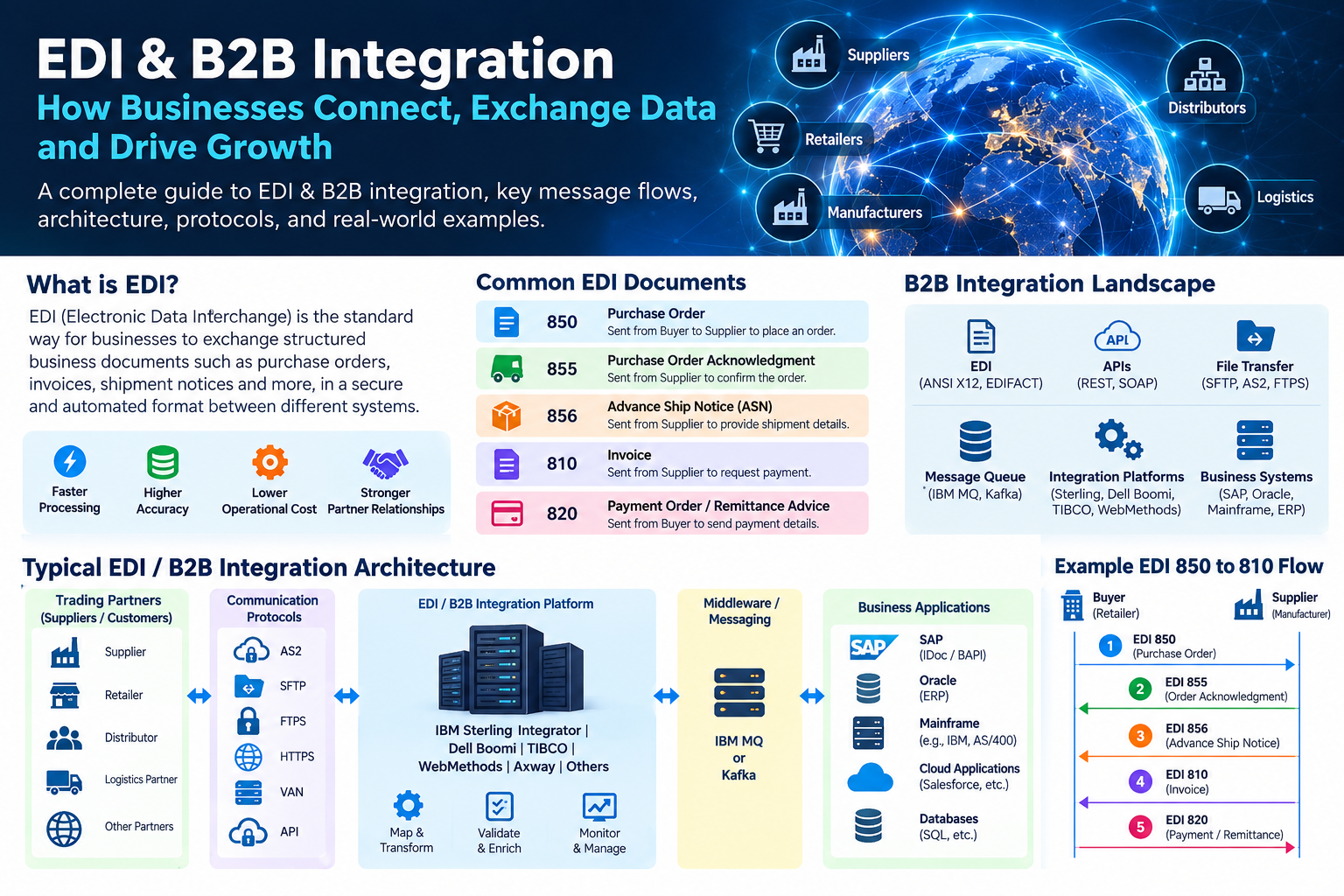
EDI is the computer-to-computer exchange of structured business documents in agreed formats. Instead of emailing a PDF purchase order and re-entering its contents into an ERP system, a buyer can send a structured EDI 850 document that the supplier’s systems process automatically.
Common standards include ANSI X12, widely used in North America, and UN/EDIFACT, used internationally. An EDI document follows standard structures, but individual trading partners may also specify mandatory segments, code lists and business rules in their implementation guides.
What is B2B integration?
B2B integration is the broader capability that connects organizations, partners and applications. It encompasses EDI, APIs, managed file transfer (MFT), transformation, routing, authentication, monitoring and exception handling. EDI is therefore one important component of a complete B2B integration architecture.
Common EDI transactions
| ANSI X12 | Document | Typical purpose |
|---|---|---|
| 850 | Purchase Order | Buyer places an order with supplier |
| 855 | Purchase Order Acknowledgment | Supplier confirms or responds to the order |
| 856 | Advance Ship Notice | Supplier communicates shipment and packaging details |
| 810 | Invoice | Supplier bills buyer for goods or services |
| 820 | Payment Order / Remittance Advice | Payment instructions or remittance details, depending on implementation |
Important: These are common examples, not a mandatory universal sequence. An EDI 997 or 999 functional acknowledgment may also be exchanged, and the business sequence depends on the trading partner agreement.
How a typical EDI/B2B architecture works
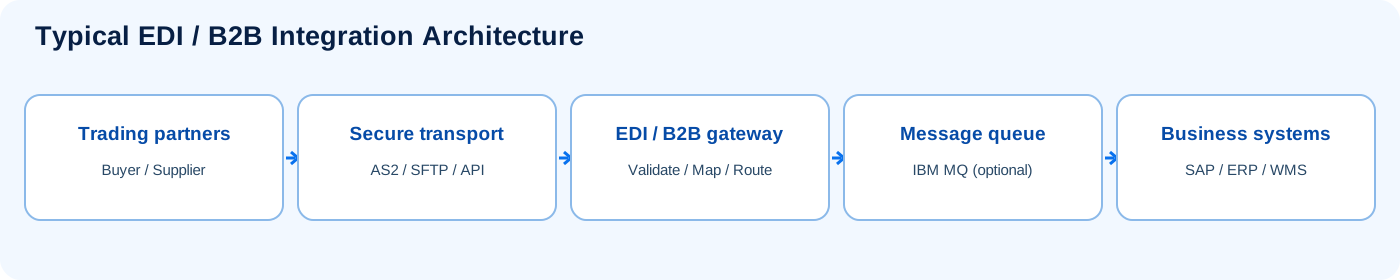
- Trading partner: A retailer, supplier or logistics provider sends a business document.
- Secure transport: AS2, SFTP, HTTPS or a VAN carries the message using agreed security controls.
- EDI/B2B gateway: An integration platform receives the message, authenticates the sender, validates structure, translates data and applies routing rules.
- Middleware: An enterprise message queue such as IBM MQ can decouple the gateway from downstream applications and support reliable processing.
- Business application: SAP, a warehouse management system, an ERP or a mainframe consumes the translated document and executes the business transaction.
For example, an inbound X12 850 may be validated and mapped to a SAP-compatible IDoc or another interface format. The receiving SAP system then creates or updates the relevant business document, subject to application configuration and business rules.
Example: purchase-order-to-payment flow
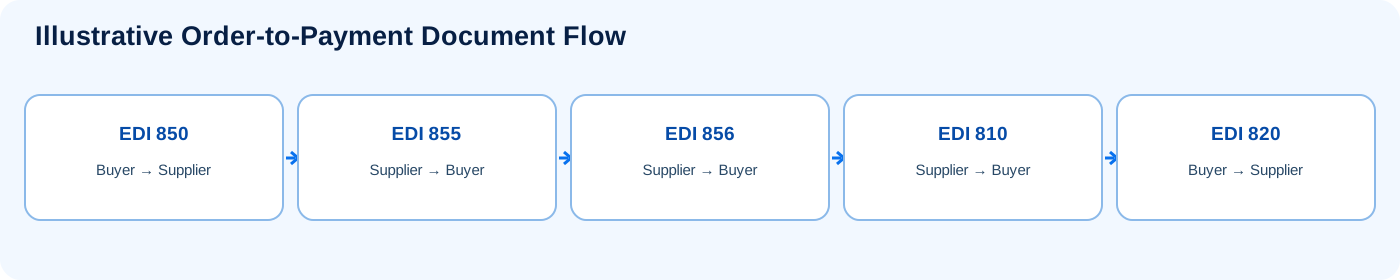
A buyer sends an 850 Purchase Order. The supplier may respond with an 855 to accept, reject or modify the order. When goods ship, the supplier sends an 856 Advance Ship Notice. The supplier typically sends an 810 Invoice, and an 820 may communicate payment or remittance details as agreed.
Which communication protocol should you choose?
- AS2: Common for direct partner-to-partner EDI over HTTP(S), with signatures, encryption and message disposition notifications where configured.
- SFTP: Widely used for secure file exchange over SSH; suitable for scheduled and event-driven transfers.
- FTPS: FTP secured with TLS, often used where established partner infrastructure requires it.
- HTTPS / REST APIs: Useful for synchronous requests, modern application integration and near-real-time exchanges.
- VAN: A third-party network service that can facilitate partner connectivity and document exchange.
Why validation and monitoring matter
Successful file delivery does not necessarily mean a business transaction succeeded. Organizations should monitor transport receipts, translation results, schema or standards validation, customer-specific rules, application acknowledgments and downstream posting results. A resilient platform should support traceability, alerting, controlled retries, reprocessing and audit logs.
Business benefits
- Reduced manual data entry and avoidable transcription errors
- Faster order, fulfillment and invoicing cycles
- Improved partner onboarding and standardized processes
- Better visibility into document status and integration failures
- More scalable operations as transaction volumes increase
Getting started with EDI/B2B integration
Begin with one high-value document flow and a small set of trading partners. Agree on implementation guides, communication protocols, certificates, acknowledgment expectations, exception handling and service levels. Build and test the mapping, validate against partner-specific requirements, and establish production monitoring before scaling to additional transactions.
Final thoughts
EDI and B2B integration are not simply about moving files. They are about making business processes dependable across organizational boundaries. Combining secure connectivity, robust mapping, validation, application integration and operational visibility creates a foundation for reliable digital commerce.
Looking to modernize your EDI and B2B integration landscape? Explore iConnectIntl’s integration services or contact the team to discuss your trading partner connectivity, EDI validation and enterprise integration requirements.